
Methodology
The Biomass Supply Chain Sweet Spot
Hinterland's proprietary five-stage feedstock assessment methodology
Biomass projects usually fail where assumptions have not been tested early enough.
After 25 years of biomass origination work across Africa, Southeast Asia, Australia, and the Americas, the pattern is consistent: projects typically fail because the origination process was incomplete. Developers run all four assessment filters simultaneously, commit serious capital to supply chain development, and discover at due diligence or at certification that a fundamental gap exists — one that could have been identified in week three for a fraction of the cost.
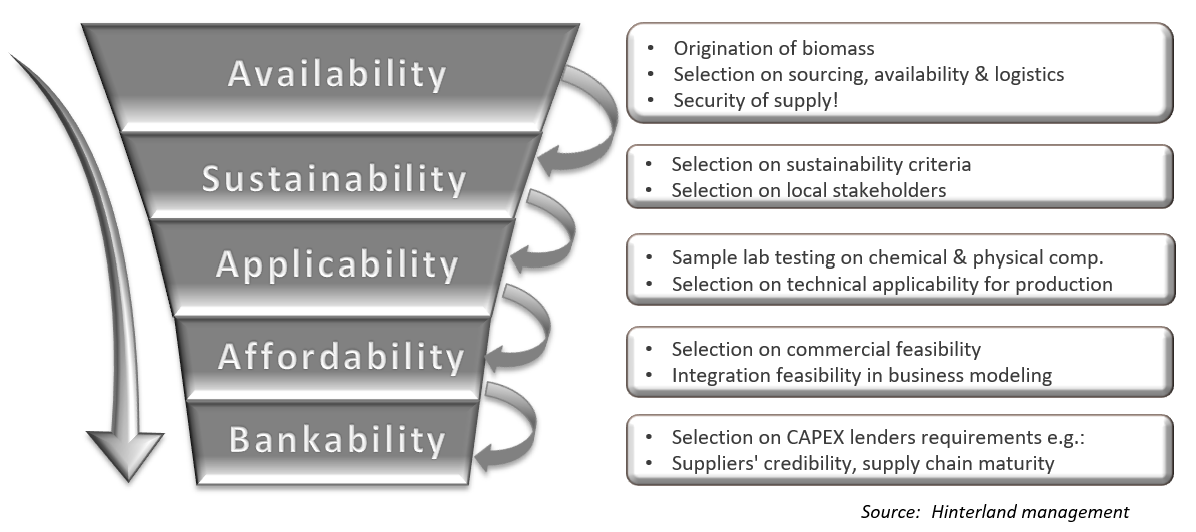
Hinterland's approach is sequential: a five-stage exclusion funnel that eliminates feedstocks on the cheapest criteria first, before committing resources to the expensive ones. The sweet spot is the narrow intersection where all five criteria align simultaneously. This methodology has been presented at the Argus Biomass Conference London (April 2026), the Global Woodchip and Biomass Trade Conference Singapore (October 2025), the World Bioenergy Association (November 2024), and the Bioenergy Insight International Biomass Congress (July 2022).
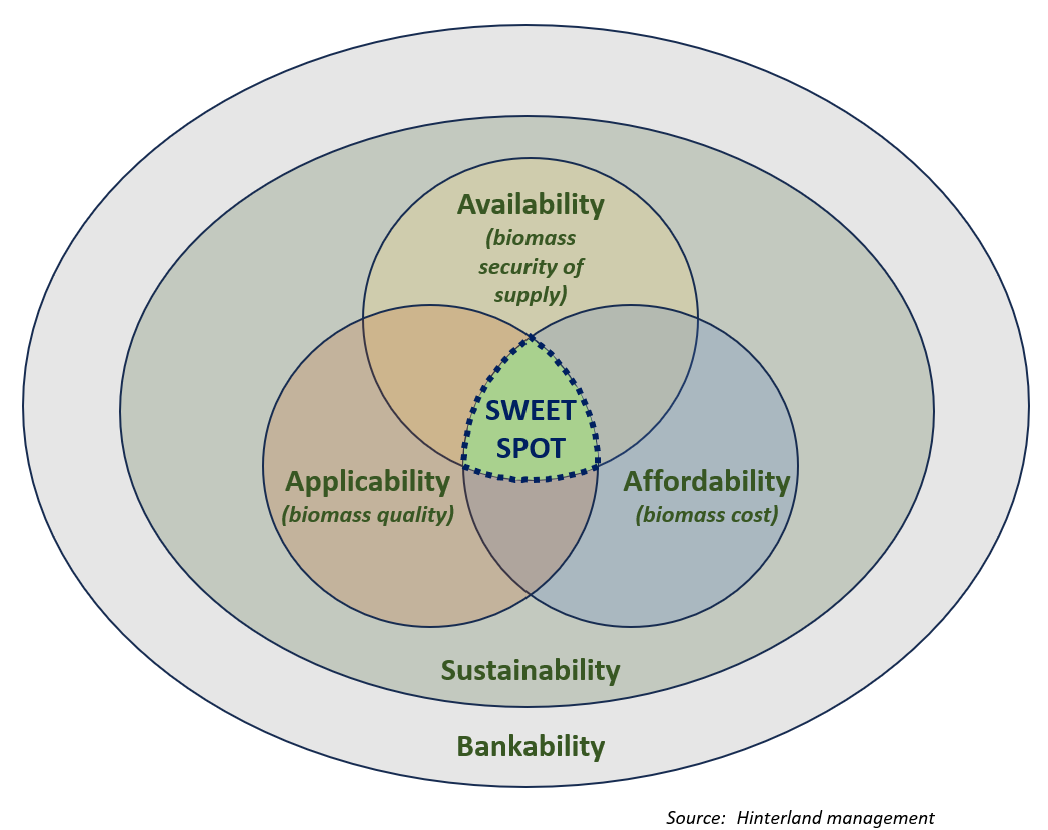
The Sweet Spot: the narrow intersection where Availability, Applicability, and Affordability align simultaneously — within the non-negotiable outer boundaries of Sustainability and Bankability.
The five stages of the feedstock funnel
Stage 1 - Availability
The first test is practical availability inside the catchment area. Hinterland looks beyond theoretical, scientific, or GIS-modelled volumes and tests what can realistically be secured: who controls the fibre, what competing uses exist, what seasonal constraints apply, how aggregation works at farm or yard level, and what volume can be procured at commercial scale.
This is the first and cheapest filter. Eliminating a feedstock at this stage costs a field visit. Eliminating it at stage four costs an investment file.
Is the resource actually there?
Assessment
Feedstock mapping
Supplier identification
Competing-use assessment
Seasonality and moisture risk
Realistic available-volume estimates
Security of supply
Stage 2 - Sustainability
Sustainability is tested early and revisited throughout the process. It should be treated as a commercial requirement, not as a late-stage compliance exercise.
A feedstock that fails on SBP, FSC, or RED III cannot be sold to a European utility regardless of its price or volume. A supply chain that fails EUDR due diligence cannot be imported into the EU. These requirements should be tested before substantial work is committed to applicability, affordability, and bankability. Early sustainability screening helps avoid supply chains that may later be blocked by certification, regulation, or market access constraints.
Can the chain carry certification and regulatory scrutiny?
Assessment
SBP / FSC / GGL / RED III certification pathway
EUDR compliance readiness
Land use and conversion risk
Local stakeholder acceptance
Social and environmental risk
Stage 3 - Applicability
Applicability is the technical filter: does the feedstock's chemical and physical composition make it suitable for the intended conversion process — pelletisation, co-firing, combined heat and power, or clean cooking? Already-dried sawdust and green agricultural stalks present very different challenges. The same feedstock at different moisture levels or particle sizes may perform completely differently through the same pellet mill.
This is where laboratory sample testing earns its cost. A €2,000 sample analysis that eliminates a feedstock is the cheapest possible outcome. A feedstock that passes this stage has been tested, not assumed.
Will the feedstock actually work in the conversion process?
Assessment
Chemical and physical composition
Moisture
Calorific value
Ash content
Pelletisation suitability
Sample laboratory testing
Specification alignment with offtaker
Stage 4 - Affordability
Affordability is the commercial filter: does the feedstock land at a gate price and CIF price that is competitive against alternatives? Driving down feedstock cost (affordability) while ensuring sufficient security of supply (availability) and acceptable quality (applicability) is the commercial optimisation problem at the heart of every biomass supply chain.
The sweet spot on the cost-quality spectrum sits at the low-cost end — agri-residues and encroaching species — where quality is reduced but so is cost, and where quality can often be managed and mitigated rather than eliminated. Each project has its own sweet spot, shaped by the specific combination of feedstock, processing technology, logistics, and offtaker requirements.
Is the feedstock commercially viable at a user gate price that works?
Assessment
Gate price modelling
Inland transport cost
Port and handling cost
Shipping cost
CIF pricing against European market benchmarks
Feedstock cost optimisation
Business model feasibility
Stage 5 - Bankability
Bankability is the final and most demanding filter: does the supply chain as a whole meet the requirements of CAPEX lenders, equity investors, and long-term offtakers? This is where supplier credibility, supply chain maturity, and the quality of the investment documentation determine whether a project closes.
If you have controlled your feedstock — if you have verified availability, sustainability, applicability, and affordability — you are already halfway to bankability. The remaining half is documentation, risk allocation, and credible counterparties.
Will funders, investors, and offtakers commit?
Assessment
Supplier credibility
Supply chain maturity
Off-take security and contract structure
Investment file quality
Risk register and mitigation strategy
Lender and investor due diligence support
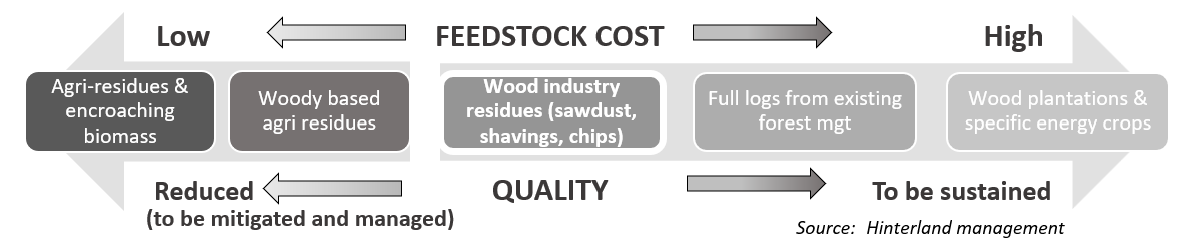
Feedstocks sit on a spectrum from low cost / low quality at one end to high cost / high quality at the other. The sweet spot for any given project is determined by the widest fuel acceptance criteria the offtaker will accept — because widening the quality tolerance expands the feedstock pool and reduces cost, at the expense of additional pre-processing investment.
How this works in practice
In practice, the funnel works as a structured decision process rather than a reporting sequence. Each stage clarifies whether the project has enough evidence to continue, or whether the work should be stopped, reframed, or redirected to the specific gap that still needs to be resolved.
Projects stopped at stage one have saved the cost of stages two through five. Projects stopped at stage three have already passed the sustainability test — they may be worth returning to with a different processing specification or a different aggregation logic.
Sequential assessment creates two forms of value: it reduces wasted cost, and it gives clients a clearer basis for deciding whether a biomass or bioenergy project can move from concept to execution.